Autonomic Response Testing (ART) according to Dr. Klinghardt
Sometimes complaints persist even though the usual tests show nothing abnormal. Autonomic Response Testing (ART), developed by Dr. Dietrich Klinghardt, is a complementary method that uses the reactions of your autonomic nervous system to look for possible hidden stress factors. We use it as an addition to, never a replacement for, conventional examinations.
Who is Dr. Klinghardt?
Dr. Dietrich Klinghardt is a German-born physician working in the United States and Europe. He is known in integrative medicine for his work on chronic illness, toxic burden, neural therapy and the role of the teeth and jaw in general health. ART is taught by the Klinghardt Academy, which offers courses for doctors, dentists and therapists every year.
What is ART?
Your autonomic nervous system works in the background and controls things like heart rate, breathing, digestion and muscle tone. According to the ART concept, the body reacts to stress, for example a toxin, an infection, a scar or an emotional conflict, through small changes in this system. These changes are read through the strength of an "indicator muscle", usually by gently pressing on your arm.
According to Dr. Klinghardt, ART is "used along with traditional tests to determine the root causes of illness. It is not used to diagnose diseases."
The five levels of healing
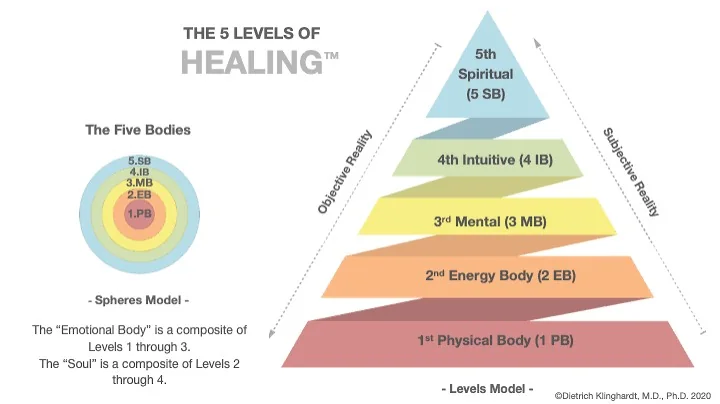
ART is based on Dr. Klinghardt's model of the "5 Levels of Healing". It describes a person in five layers, from the physical body up to the spiritual level. In this model, a problem on one level can show up as complaints on another, and lasting healing works best when the level where the problem starts is addressed.
- 1st level, physical body: structure, organs, teeth, jaw, tissues and biochemistry
- 2nd level, energy body: the nervous system and the flow of energy and information in the body
- 3rd level, mental body: thoughts, beliefs and learned patterns
- 4th level, intuitive body: deeper, mostly unconscious emotions and conflicts, often carried over from family history
- 5th level, spiritual body: your relationship with yourself, others and the bigger picture
In the model, the "emotional body" combines levels 1 to 3, and the "soul" combines levels 2 to 4. As dentists, we work mainly on the first two levels. ART helps us see whether another level may play a role, so we can refer you to the right therapist when needed.
How does a test session work?
- You lie or sit comfortably and hold out one arm. The therapist applies light pressure to test the strength of the arm muscle. It is completely painless.
- The therapist then applies small "stimuli" and observes whether your muscle reaction changes. These can be test substances held near your body, gentle pressure on an area (for example a tooth, a scar or an organ region), or thinking about a certain topic.
- A change in the muscle reaction is seen as a sign that the body is reacting to that stimulus.
- In the same way, possible remedies or treatments can be tested to see whether they neutralise the reaction.
- The findings are always discussed with you and combined with your medical history, the clinical examination, blood tests and imaging such as X-rays or CBCT.
What can ART look for?
- Possible burden from toxins and heavy metals, for example from old amalgam fillings
- Possible chronic infections or inflammation, including around root-canal-treated teeth or in the jawbone
- "Interference fields" such as scars or dental foci that may affect other parts of the body
- Emotional stress and unresolved conflicts
- Your individual tolerance of materials, medication or supplements
Why it matters in a dental practice
In biological dentistry, we look at how the teeth and jaws may be connected to the rest of the body. ART can give us extra pointers, for example when deciding which tooth or area to examine more closely with CBCT or CaviTAU ultrasound, or which materials are likely to suit you. Every treatment decision is based on the full clinical picture, not on ART alone.
Important information
ART is a complementary, experience-based method. Its results depend on the experience of the therapist and are not scientifically recognised as a diagnostic method; independent scientific studies confirming its accuracy are lacking. ART does not diagnose, treat or cure diseases and does not replace a visit to your physician, dentist or other qualified professional.
Related treatments
Detox & the dental system
An individual, medically supervised approach to reducing toxic burden, starting in the mouth.
Learn more →Chelation therapy
A medical treatment for confirmed heavy-metal poisoning, considered only under medical supervision.
Learn more →MindLINK®
A complementary method to explore stress, emotional themes, nutrition and lifestyle.
Learn more →